
Comprehensive Guide to Selecting Commercial and Industrial Freeze Dryers: From Laboratory R&D to Ton-Scale Production
Laboratory Freeze Dryers (Lyophilizers): R&D and Process Validation
Laboratory freeze dryers (also known as lab-scale lyophilizers) primarily serve university research labs, biological institutes, pharmaceutical companies, and food R&D departments. They are designed for small-batch sample processing, formulation testing, and freeze-drying process validation. Characterized by a compact footprint and flexible configurations, lab freeze dryers can be customized according to sample forms and research requirements.

Five Core Types of Laboratory Freeze Dryers
-
Standard Type (Shelf/Tray Configuration)
Utilizes internal shelves or trays. Ideal for fruits, vegetables, food products, botanical materials, and other loose bulk samples. This is the most common entry-level configuration.
-
Manifold Type
Connects multiple flasks via external manifolds, allowing simultaneous freeze-drying of separate sample groups. Highly suited for formula screening, biological samples, and comparative control experiments.
-
Stopper / Vial Capping Type
Equipped with an internal hydraulic/manual vial stoppering mechanism. Once lyophilization is complete, vials are sealed under vacuum. Primarily used in pharmaceutical R&D, biologics, and diagnostic reagents.
-
Manifold Stopper Combination Type
Combines flask manifold connectors with an internal vial stoppering mechanism. Designed for comprehensive R&D labs that need to handle both flask-based liquids and vial-based formulations simultaneously.
-
T-Frame Freeze Dryer
Employs a specialized T-frame architecture designed for wide-mouth bottles, eggplant-shaped flasks, strain preservation, and ampoule sealing for delicate biological specimens.

Selection Summary for Lab Units: Select Standard for bulk raw materials; Manifold for multi-flask testing; Stopper for vial-packaged liquids; Manifold-Stopper Combo for multi-purpose research; and T-Frame for strain preservation and ampoules.
Laboratory lyophilizers address fundamental feasibility questions: "Can this product be freeze-dried, and what are the resulting physical characteristics?" Once a product advances to pilot production, decision-makers must evaluate throughput, operational scalability, and commercial cost—bringing us to home and small commercial freeze dryers.
2. Home & Small Commercial Freeze Dryers: From Household Preservation to Micro-Entrepreneurship
Home and small commercial freeze dryers are currently the most widespread vacuum freeze drying machines in the food sector. Offering lower capital investment and user-friendly operation, these units feature an integrated (all-in-one) structure that houses both the refrigeration and vacuum drying systems in a single cabinet. They are widely used for home food preservation, all-natural pet treat manufacturing, boutique food studios, and food startups.
Market Landscape & Capacity Coverage
In the North American market, representative brands include Harvest Right, Blue Alpine, and Stay Fresh:
-
Harvest Right: Their residential line covers Small, Medium, Large, and XL sizes, with official fresh food processing capacities ranging from 6–50 lbs (~2.7–22.7 kg) per batch. Their Commercial series extends up to 65–100 lbs (~29.5–45.4 kg) per batch.
-
Blue Alpine: Serves residential and light commercial users with Medium, Large, and XL Commercial models, emphasizing high refrigeration performance and automated workflows.
-
Stay Fresh: Focuses on automated controls, -40°F (~-40°C) cold traps, integrated temperature probes, and specialized "Candy Modes."
Geliss HFD Series: Broader Commercial Scalability
Unlike consumer-centric product lines, the Geliss (Zhengzhou Geliss Intelligent Equipment Co., Ltd.) HFD Series covers a wider spectrum from home micro-businesses to commercial production, offering capacities ranging from 2 kg/batch up to 75 kg/batch.
For models above 20 kg/batch, Geliss provides customizable -80°C ultra-low temperature cold traps. This offers an ideal solution for materials with low eutectic points or high vapor-trapping requirements.
On the smart control front, the HFD Series supports remote monitoring and cloud control. Users can monitor real-time equipment status and freeze-drying curves via smartphones, tablets, or PCs. Automated data logging simplifies process analysis, parameter optimization, and batch quality traceability.

Structural Characteristics & Operating Principle
Unlike large industrial freeze-drying plants, these compact units combine pre-freezing and vacuum sublimation drying inside a single chamber:
-
The refrigeration system lowers shelf and chamber temperatures to freeze the product in situ.
-
The vacuum pump engages, initiating sublimation drying without requiring the user to transfer materials.
-
Loading, pre-freezing, vacuum drawing, and drying are completed seamlessly in one machine.
Primary Application Scenarios
Due to low entry barriers and broad material compatibility, these units process a wide variety of foodstuffs:
-
Household Preservation: Fruits, vegetables, and cooked meal storage.
-
Natural Pet Treats: Raw meat, liver, and organ treats (highly popular among pet owners).
-
Freeze-Dried Candy: Exploiting high-sugar puffing effects (popularized on social media platforms like TikTok).
-
Boutique Food Studios: Freeze-dried candied hawthorn, banana chips, mango slices, etc.
-
Aquaculture & Food Startups: Freeze-dried shrimp, salmon, and seafood to bypass cold-chain logistics.
-
Corporate R&D & Sampling: New product prototyping and small-batch market testing for traditional food processors.
[H3] Advantages & System Limitations
-
Advantages: Affordable, easy to install, compact footprint, minimal training required.
-
Limitations: Because pre-freezing, drying, and vapor condensation share one internal architecture, total throughput, cycle times, and continuous operation are bounded by system capacity. For high-sugar/high-water content foods or continuous high-volume production, simply multiplying the number of small units is rarely cost-effective.
-
Temperature uniformity across integrated shelves can also be affected by loading density and tray arrangement; thus, actual yield depends on effective loading thickness rather than nominal capacity alone.
Home vs. Small Commercial: Sizing Guidelines
-
2–20 kg / Batch: Recommended for home preservation, initial product R&D, artisanal pet treats, and micro-startups.
-
20–100 kg / Batch: Recommended for commercial food studios, small food enterprises, and producers with stable recurring orders.
Note: Standardized capacity definitions do not exist across the industry. When evaluating equipment, buyers should look beyond overall weight ratings ("kg per batch") and examine effective tray surface area, recommended loading thickness, freeze-drying cycle duration, vacuum pump performance, and cold trap ice-condensing capacity.
When production shifts from periodic batches to daily continuous output, equipment selection transitions to Pilot-Scale Freeze Dryers.
3. Pilot-Scale Freeze Dryers: Bridging Product R&D to Industrial Mass Production
Pilot-scale freeze dryers act as the crucial bridge between laboratory recipe validation and commercial mass production. Their primary function is not merely increasing batch size, but verifying whether laboratory freeze-drying curves can be stably scaled up while supplying reliable process parameters for industrial production lines.
The fundamental differentiator between pilot-scale machines and smaller commercial units lies in their heating medium and precision thermal control systems.

Core Principle: Closed-Loop Silicone Oil Circulation for Precision Temp Control
Smaller commercial units typically rely on direct electrical heating elements beneath the trays combined with radiant chamber cooling.
In contrast, pilot-scale freeze dryers utilize a recirculating silicone oil heat transfer system:
-
The refrigeration unit cools the silicone oil, which is pumped through hollow internal shelf channels to achieve uniform, rapid pre-freezing.
-
During sublimation, an electric heater modulates the silicone oil temperature. The circulating fluid distributes heat evenly across all shelves.
-
The system executes precise multi-stage temperature profiles: Pre-freezing → Thermal Hold → Controlled Ramp Heating → Primary Drying → Secondary Drying.
This precise control makes pilot units essential for rigorous R&D, recipe optimization, and high-consistency batch manufacturing.
Structural & Technical Comparison: Small Commercial vs. Pilot-Scale
| Evaluation Dimension | Small Commercial / Home Units | Industrial Pilot-Scale Freeze Dryers |
| Heat Transfer Medium | Built-in electrical heating elements; direct contact heat transfer via metal trays | Closed-loop silicone oil circulation; fluid flows through hollow internal shelf channels |
| Shelf Temp Accuracy | Temp variance $\le \pm 1^\circ\text{C}$ (meets basic food/agri needs) | Temp variance $\le \pm 0.5^\circ\text{C}$ (eliminates shelf edge effects; uniform drying) |
| System Architecture | Integrated compact cabinet; integrated piping for minimal footprint | Separate drying chamber and cold trap condenser for improved efficiency and maintenance |
| Observation Viewport | Full-view acrylic transparent door for direct visual monitoring | Heavy-duty pressure-resistant metal door with a reinforced glass sight glass for high vacuum stability |
| Control System | Industrial microcontroller with touchscreen; basic step-programming | Industrial PLC control system; complex multi-stage curve programming, data logging, user permissions, safety interlocks |
| Contact Materials | Standard configuration (aluminum alloy / standard stainless steel shelves, copper/stainless cold traps) | Sanitary-grade construction (304 / 316L stainless steel chamber and shelves; compliant with lab & pharmaceutical GMP standards) |
| Capacity & Footprint | Shelf area: 0.2 to 4.95 $\text{m}^2$; Max batch capacity: up to 75 kg | Shelf area: 1.0 to 10 $\text{m}^2$; Max batch capacity: up to 150 kg (designed for high-value batch processing) |
Target Applications for Pilot-Scale Freeze Dryers
Due to superior temperature accuracy and process repeatability, pilot-scale units are recommended for high-value or thermally sensitive materials:
-
High-Value & Functional Foods: Bird's nest, velvet antler, black truffles, caviar, and premium herbs (preserves bioactive compounds, color, aroma, and original structure).
-
Pet Fresh Food R&D: Premium chicken, beef, fish, organ meats, and complex fresh food formulations (retains natural flavor and palatability).
-
Nutraceuticals & Active Ingredients: Collagen, probiotics, enzymes, botanical extracts, functional peptides, and vitamins (demands tight moisture and temperature control).
-
Pharmaceuticals & APIs: Antibiotics, protein drugs, peptides, and heat-sensitive active pharmaceutical ingredients (improves shelf life and chemical stability).
-
Biologics & Diagnostics: Antibodies, recombinant proteins, diagnostic reagents, and cell culture components (requires strict vacuum and thermal regulation to prevent denaturation).
-
Vaccines & Clinical Samples: Viral/bacterial vaccines and clinical trial samples (reduces residual moisture to ensure thermal stability during storage and distribution).
Key Advantages of Pilot-Scale Lyophilizers
-
Precision Temperature Regulation: Circulating thermal fluid prevents localized hot or cold spots, enabling execution of complex recipes.
-
High Process Repeatability: Fixed digital control over temperature, vacuum levels, and step times ensures batch-to-batch consistency.
-
Seamless Process Scale-Up: Lyophilization curves optimized on pilot units translate directly to large-scale industrial plants.
-
Superior Product Integrity: Controlled heating rates prevent structural collapse, shrinkage, or melt-back during primary drying.
System Limitations
Pilot-scale systems involve higher structural complexity and capital investment. The silicone oil loop requires circulation pumps, heat exchangers, heating units, refrigeration chillers, and specialized control valves. Consequently, equipment and maintenance costs are higher than those of direct electric units.
💡 Industry Analogy: Home and small commercial freeze dryers function much like a household appliance—you load the product, press start, and retrieve the dried goods. They solve the question of "How do I freeze-dry this product?"
A pilot-scale freeze dryer is a precision engineering tool. It solves the question of "How do I refine and perfect a freeze-drying process so it can be reliably reproduced on a multi-ton industrial scale?"
4. Industrial Freeze Dryer Units: 200–2,000+ kg/Batch Commercial Production
When freeze-dried products enter commercial mass production, equipment design pivots from experimental flexibility to maximizing hourly throughput, energy efficiency, and total production line yield.
Industrial freeze dryers cater to pet food factories, commercial fruit/vegetable processors, instant coffee manufacturers, ready-to-eat meal producers, and large-scale agricultural operations, with batch capacities ranging from several hundred kilograms to multiple tons.

Why Large Industrial Lines Require Decoupled Pre-Freezing
Attempting to pre-freeze ton-scale loads inside a vacuum drying chamber keeps an expensive capital asset idle for hours. Decoupling pre-freezing (via blast freezing rooms) from sublimation (inside the vacuum chamber) increases drying chamber turnover rates by more than 30%.
Modern industrial plants decouple the process into three distinct steps:
Raw materials are loaded onto carts or monorail systems, frozen in dedicated quick-freezing tunnels or cold rooms until the core temperature reaches the target setpoint, and then swiftly transferred into the vacuum chamber. This ensures the vacuum chamber operates almost continuously for drying.
The Critical Role of Pre-Freezing
Sublimation requires moisture within the material to form a uniform ice crystal lattice. Freezing velocity, final core temperature, and product thickness determine ice crystal size, which directly influences pore structure, rehydration speed, and final texture:
-
Blast Freezers / Tunnels: Focus on rapid core temperature reduction for high-throughput continuous manufacturing.
-
Ultra-Low Temp Cold Stores: Provide bulk storage and thermal buffering to equalize production workflow.
-
Vacuum Drying Chambers: Specialized exclusively for vacuum sublimation and secondary desorption drying.
An industrial freeze-drying installation is not a single machine—it is an integrated processing system.
Heating Methods in Industrial Systems
While pilot units rely almost exclusively on silicone oil, large industrial plants utilize silicone oil, recirculated hot water, or steam/electric plates, depending on utility costs and temperature requirements. System design focuses on high-volume fluid distribution to ensure uniform heat input across massive tray areas without causing product collapse or thermal degradation.
Scope of Application
Industrial freeze-drying systems are built for enterprises with validated product recipes and established market demand. They transition operations from standalone equipment to automated, line-based processing.
5. Master Parameter Comparison Matrix Across All 5 Freeze Dryer Types
| Freeze Dryer Category | Batch Capacity | Core Pre-Freezing Method | Temp Control Medium / Heating Method | Primary Application Fields |
| Laboratory Type | 1 – 5 kg | Cold trap radiation / External freezer | Ambient air sublimation / Optional unheated shelves | Academic research, strain preservation, reagent R&D |
| Home Type | 2 – 20 kg | In-situ cold trap refrigeration | Direct electric heating elements | Home preservation, small pet treats, micro-startups |
| Small Commercial | 20 – 100 kg | In-situ cold trap refrigeration | Electric shelf heating | Commercial food studios, e-commerce product testing |
| Pilot Scale | 2 – 200 kg | In-situ silicone oil cooling | Closed-loop silicone oil circulation ($\pm 0.5^\circ\text{C}$) | High-value foods, vaccines, biologics, pharmaceuticals |
| Industrial Units | 200 – 2,000+ kg | Decoupled blast freezer / Cold storage | Recirculating silicone oil / Hot water / Heating plates | Pet food plants, bulk produce, instant coffee, agri-processing |
Note: Home and small commercial units share similar underlying architecture. The maximum single-cabinet capacity for Geliss HFD commercial units is 75 kg/batch.
6. Selection Recommendations & Geliss End-to-End Freeze-Drying Solutions
Selecting a freeze dryer should never be reduced to asking "How much does a machine cost?" Proper equipment selection is a comprehensive engineering decision aligned with your operational stage:
-
Home Use or Initial Lab Prototyping: Prioritize low equipment acquisition cost, compact footprint, and operational simplicity.
-
Early-Stage Startups & Small Studios: Focus on effective batch yield versus utility cost per unit of finished product.
-
Established Businesses with Recurring Orders: Evaluate annual equipment utilization rates, cycle time optimization, and future capacity scalability to avoid bottlenecks as sales grow.
-
Ton-Scale Commercial Processing Plants: Design a holistic manufacturing system covering facility layout, blast freezer integration, automated material handling, utility matching, and centralized PLC control.
From laboratory testing and process validation to complete ton-scale plant engineering, Geliss provides end-to-end technical support to protect your capital investment.
If you are planning a new freeze-drying project or seeking to optimize existing production cycles, contact our engineering team for detailed technical consultations and tailored plant proposals:

-
Official Website: www.geliss.com
-
Direct Email: simonshi@geliss.com
-
WhatsApp / Phone: +86 18203666396
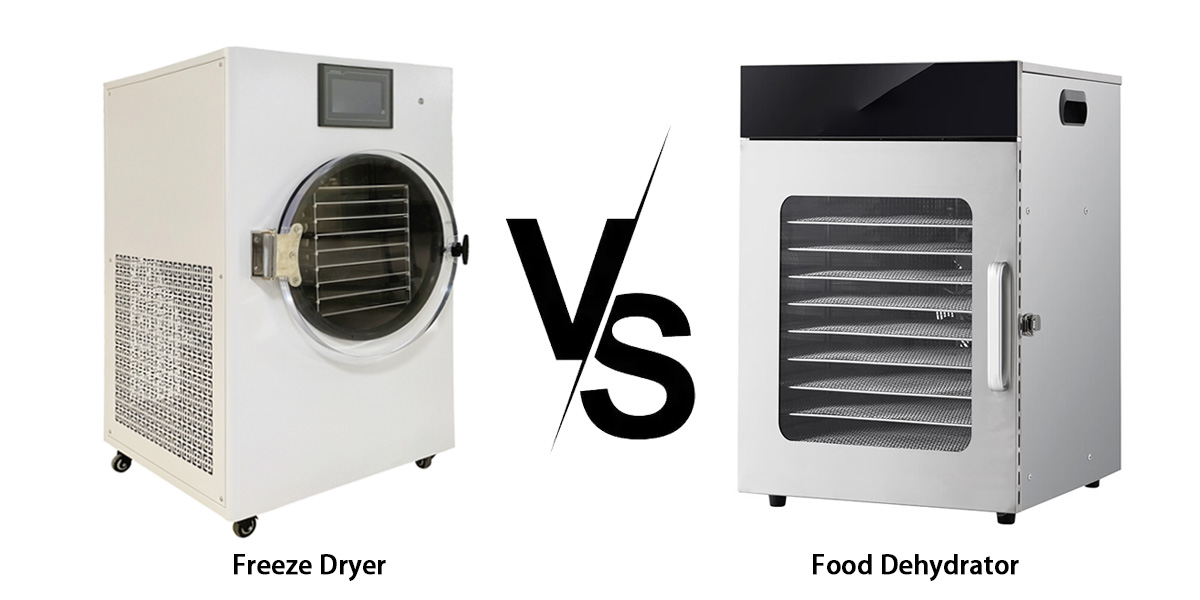
What is the difference between a food freeze dryer and a food dehydrator?
SEND MESSAGE